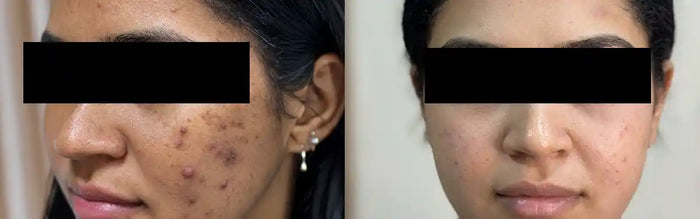
73.2% of Indian Patients Said Acne Is Not a Phase

Most of us were told breakouts fade with age. The data says otherwise, and the checklist at the end shows what to change first.
73.2% of patients in an Indian dermatology study had acne that continued from adolescence into adulthood.
India has 1,000+ skincare brands. And still, the breakouts keep coming.
If you've spent years switching products and waiting for it to end, that's years of the same loop.
It's the most familiar story in skincare, and the most under-questioned.
Here's the conventional wisdom. Spot a pimple, dry it out, wait for the next one. Acne is a teenage thing, and you'll grow out of it.
If acne is just a phase, why do so many people outgrow their teens and not their breakouts? Could the answer be to condition acne-prone skin rather than keep treating breakouts?
Treating goes after the pimple you can see. Conditioning asks why your skin keeps making them, then supports it over weeks.
It won't work overnight, and it won't make acne disappear. But it works on the real reason pimples keep coming back.
In this guide:
-
Is acne just a phase, or does it continue into adulthood?
-
Why you may still have acne as an adult, and what besides hormones plays a part
-
Drying your skin out can backfire
-
Conditioning, not just treating: Clear, Balance, Calm
-
Where this argument falls short
-
A five-line checklist you can copy tonight
Is acne just a phase, or does it continue into adulthood?
Almost everyone gets it at some point
Start with how common it is. In India, around 9 in 10 teenage boys and 8 in 10 teenage girls deal with acne. So if you're breaking out, you're in a very large company.
For many people, acne never leaves
In one Indian study, 73.2% of patients still had acne well into adulthood. That is a pattern, not a phase.
And most of those people weren't doing anything. They were switching products, trying quick fixes, waiting for it to end.
Why you may still have acne as an adult, and what besides hormones plays a part
Hormones get blamed for a lot, but for many women over 25, everyday life plays a big part too: late nights, sugar, dairy, pollution, stress.
A spot gel can't fix your sleep or the air outside your window. So if hormones are only part of the story, a surface-level fix answers the wrong question.
Drying your skin out can backfire
Some sources suggest Indian skin may carry more active oil glands. This isn't fully proven yet, but the idea makes sense. But follow the logic: strip the oil hard, and skin may respond with even more.
Conditioning, not just treating: Clear, Balance, Calm
This is the spine we'll use across the acne series.
Clear. Gently loosen the buildup inside pores so they stop clogging.
Balance. Regulate oil rather than strip it.
Calm. Soothe visible redness and keep skin hydrated so the barrier copes with pollution and stress.
Give any routine 8-12 weeks before judging it.
Where this argument falls short
We haven't cited a study that compares treating with conditioning head to head. This case rests on prevalence, persistence and cause data, plus the logic that follows.
Some numbers come from patient samples, which may not reflect everyone with acne. One comes from a non-clinical source.
Conditioning is also slower. One stubborn pimple before an event may still deserve a spot treatment.
And if your acne is severe, painful or cystic, see a dermatologist. This is for mild to moderate, everyday breakouts.
A five-line checklist you can copy tonight
-
Cleanse with a gentle gel cleanser. Massage 30 seconds, rinse lukewarm.
-
Apply a lightweight pore-clearing, oil-balancing serum on slightly damp skin.
-
Moisturise with a light, non-comedogenic gel. Oily skin needs one too.
-
Protect with broad-spectrum sunscreen every morning.
-
Swap the one harsh product you use most for something gentler, and add only one new product at a time.
At night, repeat steps 1-3.
What's the strangest thing you've put on a pimple hoping it would work? There's no wrong answer. Tell us in the comments.
Got your own acne story? Send it to contact@kasscare.com, and we may feature it in the next post in this series.