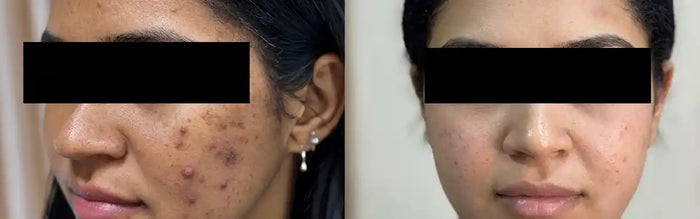
Best Face Serums for Oily Skin in India.

A 10% niacinamide serum or any vitamin C serum isn't always the answer for active acne, enlarged pores that look bigger every week, and skin that gets shiny by noon.
These are good ingredients, but they're being sold as the answer to every oily-skin problem, and oily skin rarely has just one.
You might be shiny by noon. Your pores might look bigger every time you check. You might have a breakout that won't settle, or dark marks left behind by the last one. Often, it's all four at once. These problems are connected, but they aren't the same, and no single ingredient can fix all of them.
This guide explains how oil, pores, breakouts and marks are linked, which serum ingredients work at each stage, and how to choose a serum based on the concern that bothers you most.
In this guide:
-
Why oily skin needs more than one fix
-
Serum ingredients that actually work for oily skin and your concern: breakouts, pores, shine or marks
-
How to use serums on oily skin, morning and night
-
Five mistakes that make oily skin worse
-
Kass serums for oily skin
-
Key takeaways and FAQs
Why Your Oily Skin Needs More Than One Fix: The Oil-to-Marks Chain
Shine, open pores, breakouts and dark marks aren't four separate problems. They're four stages of one chain, and each stage needs a different kind of help.
Each stage feeds the next: excess oil clogs pores, clogged pores break out, and breakouts leave marks behind.
Stage 1: Excess oil
Oil, or sebum, is made by sebaceous glands attached to your pores. How much you produce is set mostly by genetics and hormones, which is why oily skin often runs in families and flares with hormonal shifts. Heat and humidity, a fact of life in most of India, make that oil more visible on the surface. On its own, sebum isn't the enemy. It protects and softens skin. The trouble starts when there's more than the pore can clear.
Stage 2: Clogged and stretched pores
Excess oil mixes with dead skin cells inside the pore and forms a plug. Plugged pores show up as blackheads and whiteheads, and over time the build-up stretches the pore opening so it looks larger. Pores don't open and close like doors, but a pore that stays clear and less congested does look smaller and smoother.
Stage 3: Breakouts
A clogged pore is a low-oxygen pocket full of oil, which is exactly where acne-causing bacteria thrive. As they multiply, the skin responds with inflammation, and a blocked pore becomes a red, swollen pimple.
Stage 4: Marks left behind
Inflammation tells pigment cells to make more melanin. When the pimple heals, a flat brown mark often stays behind. This is post-inflammatory hyperpigmentation, and it's especially common and long-lasting on Indian skin. Pick or squeeze the pimple, and the mark usually gets darker and lasts longer.
Why this matters for choosing a serum: a serum that works on stage 1 won't clear a breakout already at stage 3, and a serum built for breakouts won't fade the marks at stage 4. The smartest routine works on the stage where your skin is stuck, and on the stage before it, so the chain stops repeating.
Serum Ingredients That Actually Work for Oily Skin & Your Concern: Breakouts, Pores, Shine or Marks
Start with the concern that bothers you most, then match the serum to it.
|
Your main concern |
What you notice |
Look for |
Skip |
|
Shine |
Face looks greasy by midday; makeup slides off |
Niacinamide, zinc PCA, lightweight hyaluronic acid |
Heavy oils, rich creams as your serum layer |
|
Open pores |
Visible pores on nose and cheeks; rough, uneven texture |
Niacinamide with zinc PCA, willow bark, gentle BHA |
Pore strips and harsh scrubs, which irritate and stretch skin |
|
Blackheads and whiteheads |
Small bumps and dark dots, mostly on the T-zone |
Salicylic acid, willow bark |
Physical scrubs |
|
Active breakouts |
Red, sore pimples that keep returning |
Salicylic acid with calming botanicals; azelaic acid |
Toothpaste, lemon, picking |
|
Acne marks |
Flat brown or dark spots left after pimples heal |
Alpha arbutin, lactic acid, azelaic acid |
Strong peels before you've calmed breakouts |
When you have more than one concern
For most oily skin, a simple rule works: one serum to manage oil and pores, plus one for your biggest problem.
-
Shine and pores, with the odd breakout: a niacinamide serum in the morning, a salicylic acid serum at night.
-
Breakouts and the marks they leave: a salicylic acid serum to calm and prevent breakouts, plus a pigmentation serum for the marks. Clear the breakouts first, or new marks keep forming.
-
Pores and marks: a niacinamide serum in the morning, a pigmentation serum at night.
Two serums are usually the ceiling. Layering three or four actives on oily skin is a common cause of irritation, and irritated skin breaks out and marks more easily.
How to Use Serums on Oily Skin, Morning and Night
A serum works best in a short, steady routine. Here's a simple version for oily skin.
Morning: control and protect
-
Cleanse with a gentle face wash that leaves skin clean, not squeaky or tight.
-
Serum: your oil-and-pore serum, such as niacinamide with zinc. Two or three drops are enough for the whole face.
-
Moisturise with a lightweight gel moisturiser. Skipping this leaves oily skin tight underneath and shiny on top.
-
Sunscreen: a broad-spectrum SPF 50 with a matte or gel finish. Sun darkens acne marks, so this step protects everything your serums are doing.
Night: treat and repair
-
Cleanse. If you wore sunscreen or makeup, double cleanse. A salicylic acid face wash works well as the second step for acne-prone skin.
-
Serum: your treatment serum for breakouts or marks.
-
Moisturise with your gel moisturiser.
Five Mistakes That Make Oily Skin Worse
-
Using too many actives at once. Introduce one new serum at a time, and give it two weeks before adding another.
-
Over-cleansing. Washing more than twice a day, or with harsh foaming cleansers, irritates skin and can make breakouts worse.
-
Skipping moisturiser. Oily skin still needs water. Pick a light gel, not nothing.
-
Expecting overnight results. Oil and pore changes show in two to four weeks; breakouts settle in four to eight; marks fade over two to three months.
-
Picking at spots. Every squeezed pimple is a new dark mark waiting to happen.
If your serum stings, burns or causes peeling that doesn't settle within a few days, stop and reassess. For persistent or painful acne, see a dermatologist.
Kass Serums for Oily Skin: One for Each Stage of the Chain
At Kass, we don't build serums around a single hero ingredient. We build them around a problem. Oily skin isn't one problem, so we made a serum for each stage of the chain, designed to work alone or together.
|
Serum |
Stage it targets |
Technology |
Key actives |
Choose it if |
|
Pore Minimizer Serum |
1 and 2: Oil and pores |
Quadraplex Pore Effect™: decongestion, oil control, hydration and collagen renewal |
Niacinamide, zinc PCA, willow bark, green lentil extract, hyaluronic acid |
Shine and open pores are your main concern |
|
Acne Solutions Serum |
2 and 3: Clogged pores and breakouts |
360° Acne Conditioning: changes the skin environment that lets acne return |
Salicylic acid, willow bark, rosa canina, clove, green tea, basil |
Breakouts keep coming back |
|
Depigmentation Serum |
4: Marks left behind |
Adaptive Precision Technology™: works across pigment production, transfer and the surface |
3% lactic acid, alpha arbutin, Palmaria palmata, kesar, neroli, hyaluronic acid |
Acne marks or dark spots linger after breakouts heal |
How to pair them
-
Shiny skin with open pores: Pore Minimizer Serum, morning and night.
-
Oily skin with regular breakouts: Pore Minimizer Serum in the morning, Acne Solutions Serum at night.
-
Breakouts that leave marks: Acne Solutions Serum at night to break the cycle; once breakouts settle, bring in the Depigmentation Serum at night and keep the Pore Minimizer in the morning.
Finish every routine with a light moisturiser such as the Mattifying Gel Moisturizer and a daily sunscreen. For acne-prone skin, the Oil Cleanse Face Wash with 1% salicylic acid works well as your evening cleanser.
Why Choose Kass for Oily Skin?
Whether your oily skin shows up as shine, open pores, breakouts or the marks they leave, Kass helps you build a routine around the stage your skin is stuck at, not just what's visible on the surface.
-
Built for the chain, not one symptom: Each serum targets a different stage, from excess oil to post-acne marks, so they work together instead of overlapping.
-
Multi-action formulas: Instead of one ingredient at a high percentage, each serum combines several actives that work on the same problem from different angles.
-
Made for Indian skin and climate: Lightweight textures for heat and humidity, and gentle actives chosen with Indian skin's tendency to mark in mind.
-
Root-cause thinking: Kass formulas aim to bring oily skin back into balance rather than stripping it, so results hold up over time.
Key Takeaways
-
Shine, open pores, breakouts and acne marks are four stages of one chain. Choose your serum by the stage your skin is stuck at.
-
Niacinamide and zinc PCA help manage oil and pores. Salicylic acid clears inside the pore. Alpha arbutin and lactic acid help fade marks.
-
Most oily skin does best with two serums: one for oil and pores, one for your biggest concern.
-
Keep the routine short, never skip a light moisturiser or sunscreen, and don't pick.
-
Give serums time: two to four weeks for oil and pores, longer for breakouts and marks.
Face Serums for Oily Skin: Your Questions, Answered
Can I use two serums together on oily skin?
Yes. The simplest way is one in the morning and one at night. Introduce them one at a time, two weeks apart, so you know how your skin reacts to each.
Which serum helps with open pores?
Look for niacinamide with zinc PCA and a gentle pore-clearing ingredient like willow bark. These keep pores clear and less congested, so they look smaller and smoother over time.
What serum should I use for acne marks on oily skin?
A pigmentation serum with ingredients like alpha arbutin and lactic acid, used at night, plus sunscreen every morning. Control breakouts first, or new marks keep forming.
Do I still need a moisturiser if I use a serum?
Yes. Most serums treat; a moisturiser keeps water in. Oily skin does best with a lightweight gel moisturiser on top.
How long does a serum take to work on oily skin?
Oil and pore changes usually show in two to four weeks. Breakouts settle over four to eight weeks, and acne marks fade over two to three months with daily sunscreen.
Can a serum make oily skin break out?
A heavy or irritating serum can. Choose lightweight, non-comedogenic formulas, introduce one at a time, and stop any product that keeps stinging or causes new bumps.